Posts

Showing posts with the label Tonacatepeque

The Lutheran Trifecta: The Part with Saints and Spooky Tales
Image
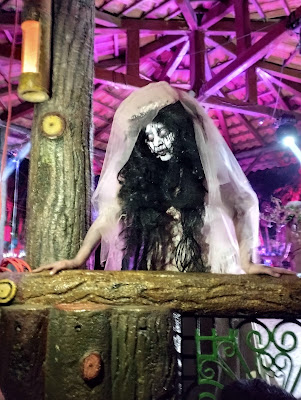
Día de los Santos - All Saints Day is a Christian holiday, celebrated in a variety of ways depending on theological, geographical and cultural tradition.  In our Lutheran Church community in El Salvador, this is the day on which legends are brought to life. Perhaps not your typical All Saints Day Lutheran Church photo.  This is an image of The Screaming Bride - one of the legends illustrated by live actors in the Festival of the Calabiuza  (photo used with permission from a friend) Here's a bit of old school history:  The description of a feast day in commemoration of multiple saints or martyrs can be found in writings from the early times of the church (prior to 400 C.E.).  In the late 700's C.E., Pope Gregory III is said to have dedicated a chapel in honor of all saints and martyrs on the date of November 1st, and by the 800's C.E. the Festival of All Saints is widely recognized and celebrated on this date. In medieval England, the Feast of All Saints (also kn...

Celebration at the Gym: A story of dreams and determination

Image
Sometimes, dreams come true.  This is the story of a gym. A gym made of dreams and determination. The gym is getting ready for a party! In a way, the gym story begins in Milwaukee. We have a friend, a professor at Marquette University, who was and is doing investigative work in preparation for authoring an academic paper with a focus on violence. In the course of things, she grew in understanding the impact of violence-based trauma in her own life and in the life of a small Salvadoran community. She began looking at her research topic through a different lens. Seeds were planted. Relationships grew. And so did an idea: to plant a free community gym in the center of Comunidad Romero in Tonacatepeque, El Salvador. Leaders decided to locate the gym right next to the Casa Comunal (community house)  as a sign that this gym is not a gym only for gym bros, not a gym to push diet plans or supplements, not a gym selling sexiness, but a free community gym where all people are ...

The Legend of the Priest with no Head

Image
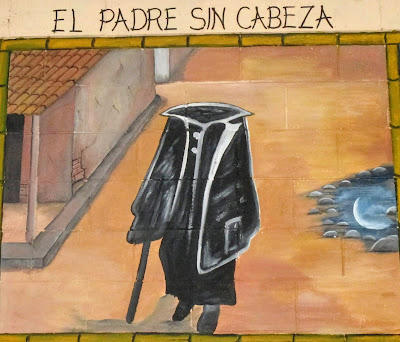
Tales of mysterious encounters with a headless priest in the dark of night are not uncommonly told among the Salvadoran people.  After the time of the Spanish invasion, when conquerors wielding swords or carrying Bibles established their power, there emerged a legend of an imaginary priest who wanders in the streets and pathways as a lost soul. He appears to those who are out walking in the evening. He is searching for his head.  He, or perhaps his head, lets out screams into the night. Those who see him feel cold and are sometimes paralyzed with fear and cannot speak for days. The story of the Priest with no Head is well-known and frequently told in Tonacatepeque.  Some say the ghost of El Padre sin Cabeza (the headless priest) is real. Some say the story was invented by the church in order to scare indigenous people into becoming Christians. Some who study traditional, Salvadoran tales say this legend was created by enemies of the church.   A painting of ...

The Legend of the Grandmother's Jug

Image
Many of the post-colonial legends from Tonacatepeque were created in order to teach lessons such as: don't go out at night alone, don't be unfaithful to your beloved, you can't hide misbehaviors from the church (or God), bad choices have consequences, etc. Some of the stories, like this one, share a little bit about history, a little bit about nature, and a little bit of humor. This is just one of several "buried treasure" tales which one might be told. Photograph taken at a temporary exhibit in the gallery at Parque Cuscatlán The Legend of the Grandmother's Jug In the olden days, it was customary to use a botija as a safe place in which to keep documents or treasures.  The botija  is like a traditional water jug (maybe shaped like an urn), but we could think of it as a pot, a jar, or any kind of container in which one could keep something. It was the custom of the generations which came before us, to keep any extra money not immediately needed in something l...

The Legend of the Flirty Parrot

Image
We walked toward the edge of town. "What's the story about that old church?" I asked. The building looked nearly abandoned. "That is the Iglesia Catolica El Calvario.  They are working on the church, I think, but they still meet. This neighborhood is called El Calvario. When we walk to the edge of town, we say we are going to El Calvario . It's an expression we use because we say at the edge of every town, it is called El Calvario.  'We will meet you at Calvary' means we will meet you at the edge of town." There is a story from this neighborhood of Tonacatepeque, El Calvario. Like many of the legends from Tonaca, this one is meant to cause the listeners to think about their behavior. Thanks to Sonia and the women's group in Tonaca as well as author José María Melgar Callejas for this story. The Legend of the Flirty Parro t    In the outer corridor of a house in El Calvario, there was a bird cage, and inside the cage, there was a guest - a parrot ...

The Legend of the Bald Buzzard

Image
On an ordinary evening in Tonaca, in an ordinary and dimly lit room, the rhythmic words of an ordinary  story-teller may be heard - ordinary words weaving themselves together in an extraordinary tale. Tonacatepeque is known for its tales.  In multi-generation households, the elders still spin their stories into the imaginations of their grandchildren.  Although many families may not be sitting around lit candles and sharing spooky stories well into the evening, the town's cultural center works with the local schools, community radio station and the mayor's office to keep Tonaca's traditions alive. October begins with the Day of the Child, and in Tonaca, ends with the festival of la Calaviusa*. It seems the perfect month for sharing a few mysterious tales.  Stories passed on through oral tradition often have many versions, because each story teller incorporates not only what they have heard over the years, but also what they themselves have experienced.   Af...

The Squeaky Cart

Image
In honor of Halloween...here is the story of La Carreta Chillona This photo was taken in the Cultural House in Dulce de Nombre de Maria, Chalatenango Throughout El Salvador, the midnight sound of squeaky wheels rolling down pavement, cobbles or pathways of a town brings fear to those who hear it.  The cart passes by at the time when everyone should be asleep, so that no person of the town would be exposed to the company of cadavers traveling by cart on their funeral route.  Some believe the cart is filled with the bodies of those who have dared to look upon the squeaky cart as it passed by. Many people claim to have heard the squeaky cart, and many people will describe its distinctive adornment with skulls, but I have not yet met a person who has taken a peek as it passes by in the night. Historians believe that versions of this tale were spread throughout the Americas by Spanish rulers, who wanted to discourage the local people from venturing out after dark to conspire...